


Dans quelle mesure le routeur JRS Eco 100 émet-il moins de rayonnement qu’un routeur standard ? Dans ce test, nous utilisons deux appareils de mesure de la pollution électromagnétique couramment utilisés — un mesureur RF Safe and Sound II et un Cornet ED98 QPro 5G — pour mettre en évidence les différences.
Champs électromagnétiques mesurés à partir d’un routeur WiFi ordinaire
La puissance d’émission d’un routeur WiFi ordinaire est généralement réglée par défaut sur 100 milliwatts. À une distance de 2,5 mètres, avec les réglages d’usine par défaut, nous avons mesuré un niveau de champ électromagnétique continu de 31 300 microwatts par mètre carré, mesuré à l’aide du mesureur RF Safe and Sound Pro II. Les résultats varient en fonction de la marque et du type de routeur, mais se situent généralement dans une fourchette de plusieurs dizaines de milliers de microwatts par mètre carré. Sur certains routeurs, la puissance d’émission peut être réglée, mais souvent uniquement par paliers très grossiers — par exemple, pas en dessous de 33 % — et, pour certaines marques, ce n’est pas possible du tout. De plus, le nombre d’impulsions est un facteur important : un routeur WiFi ordinaire émet 10 impulsions de balise par seconde, 24 heures sur 24.
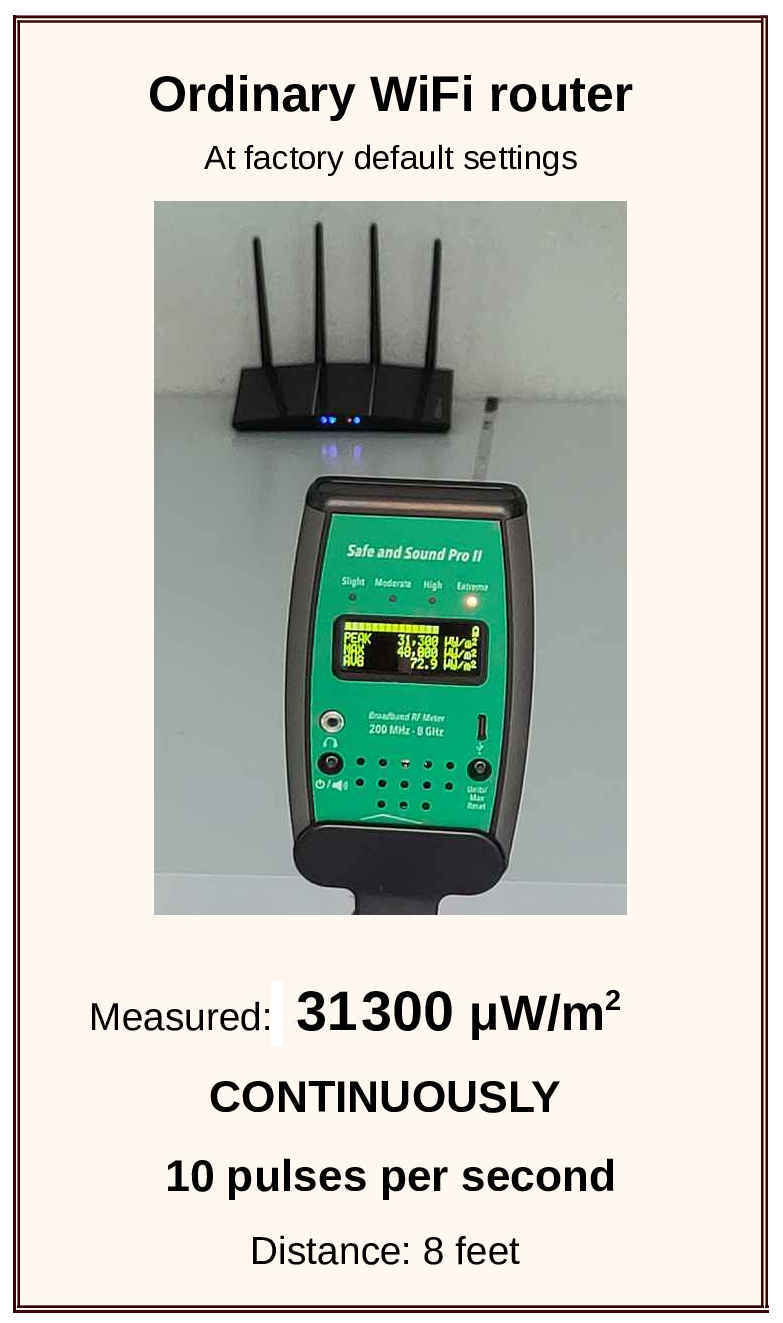 Figure 1. Les champs électromagnétiques mesurés à partir d’un routeur WiFi ordinaire avec les réglages d’usine par défaut s’élèvent à 31 300 µW/m², avec 10 impulsions par seconde. Mesure effectuée à l’aide d’un mesureur RF Safe and Sound Pro II à une distance de 2,5 mètres. Cliquez sur l’image pour l’agrandir.
Portée et champs électromagnétiques mesurés en fonction du réglage de la puissance d’émission du routeur JRS Eco 100 Era
Le routeur JRS Eco 100 Era émet des champs électromagnétiques nettement moins puissants. Son niveau par défaut est bien moins élevé que celui des routeurs ordinaires et il dispose d’un réglage très précis de la puissance d’émission, ajustable par paliers de 1 dB. Cela vous permet de définir exactement la portée dont vous avez besoin, sans excès, grâce à 20 paliers allant de 1 milliwatt à 100 milliwatts. De plus, le nombre d’impulsions par seconde est réduit de 87 %, pour atteindre environ une impulsion par seconde.
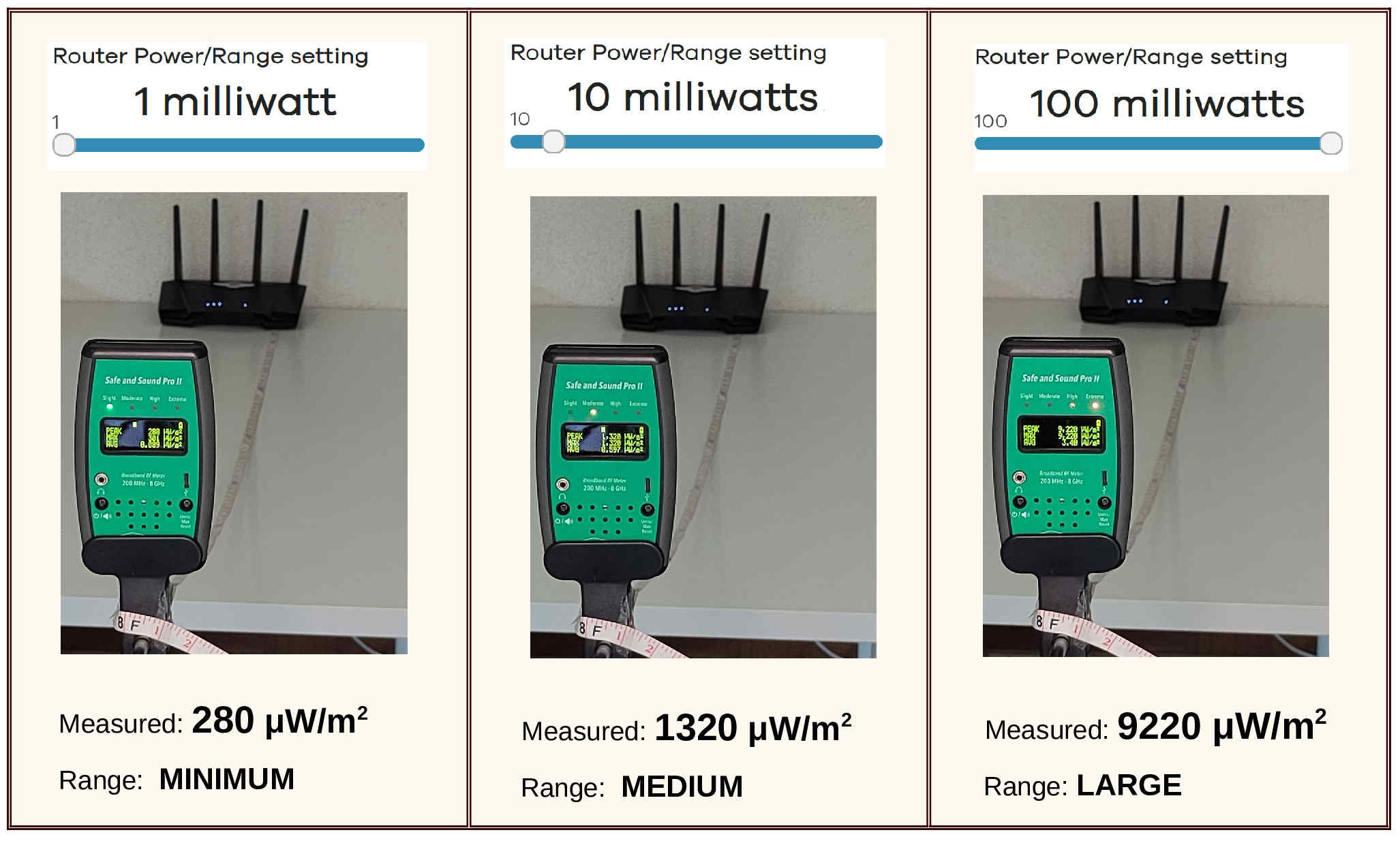 Figure 2. Avec une puissance d’émission réglée sur 1 milliwatt, le routeur JRS Eco 100 Era présente les émissions de champs électromagnétiques les plus faibles du marché : 280 µW/m², mesurées à l’aide d’un mesureur RF Safe and Sound Pro II à une distance de 2,5 mètres. Cliquez sur l’image pour l’agrandir.
Il est important de comprendre que la puissance d’émission est indissociable de la portée d’un routeur — c’est une réalité physique incontournable. Nous livrons les routeurs JRS avec une puissance d’émission de 20 milliwatts par défaut (auparavant 63 milliwatts), ce qui offre une portée suffisante pour un logement de taille moyenne. Vous pouvez régler manuellement la puissance d’émission en fonction de vos besoins, ce qui vous permet d’obtenir exactement la portée souhaitée. A une puissance de 1 milliwatt, le routeur JRS Eco 100 Era présente les niveaux de CEM les plus faibles parmi les routeurs WiFi disponibles sur le marché. À l’aide du mesureur Safe and Sound, nous avons mesuré un niveau de seulement 280 microwatts par mètre carré (µW/m²) à une distance de 2,5 mètres.
Ces niveaux sont mesurés avec le WiFi activé sur le routeur JRS Eco 100. Lorsqu’aucun appareil WiFi n’est connecté, le routeur JRS 100 % exempt de CEM.
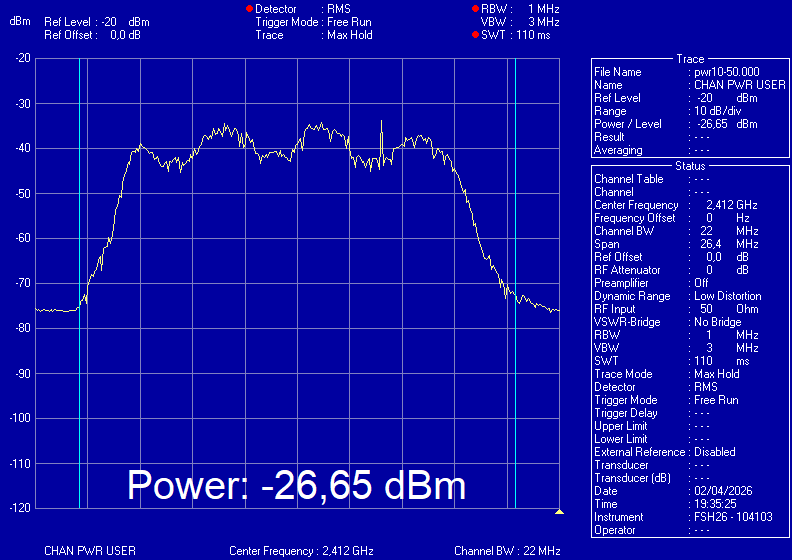
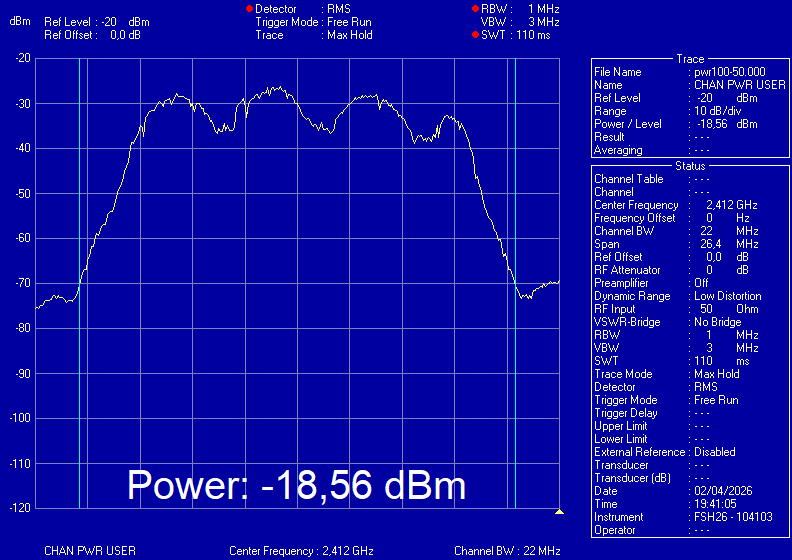
Pour le scénario avec le WiFi actif, le tableau ci-dessous indique le niveau exact de rayonnement émis mesuré. Étant donné que les différents modèles de mesureurs de CEM réagissent différemment, nous avons inclus les mesures prises à la fois avec le mesureur RF Safe and Sound Pro II et le mesureur Cornet ED98 QPro 5G afin de faciliter la comparaison. Le mesureur Safe and Sound est plus sensible aux fréquences WiFi que le mesureur Cornet et affiche donc des valeurs plus élevées.
| JRS Eco 100 Era
Réglage de la puissance / de la portée * [milliwatts] |
Portée | Mesurée avec le WiFi activé. (Lorsque le routeur JRS est en mode veille, l’émission RF est nulle.) | |||
|---|---|---|---|---|---|
| Mesure effectuée à l’aide d’un mesureur RF Safe and Sound Pro II à une distance de 2,5 mètres | Mesure effectuée avec le Cornet ED98 QPro 5G à une distance de 0,6 mètre | Mesure effectuée à l’aide de l’analyseur de spectre Rohde & Schwarz FSH6 à une distance de 0,6 mètre | |||
| Densité de puissance [µW/m²] (Plus la valeur est faible, plus le champ électromagnétique est faible) | Puissance du canal [dBm] (Plus la valeur est élevée, plus le champ électromagnétique est faible, échelle logarithmique) |
||||
| 1 ← Le plus faible niveau d’EMF du marché | Minimum | 280 | 290 | -34 | -33,4 |
| 10 | Moyen | 1 320 | 1 076 | -26 | -26,7 |
| 100 | Grand | 9220 | 7110 | -18 | -18,6 |
* Comment puis-je régler la puissance d’émission du JRS Eco 100 Era ?
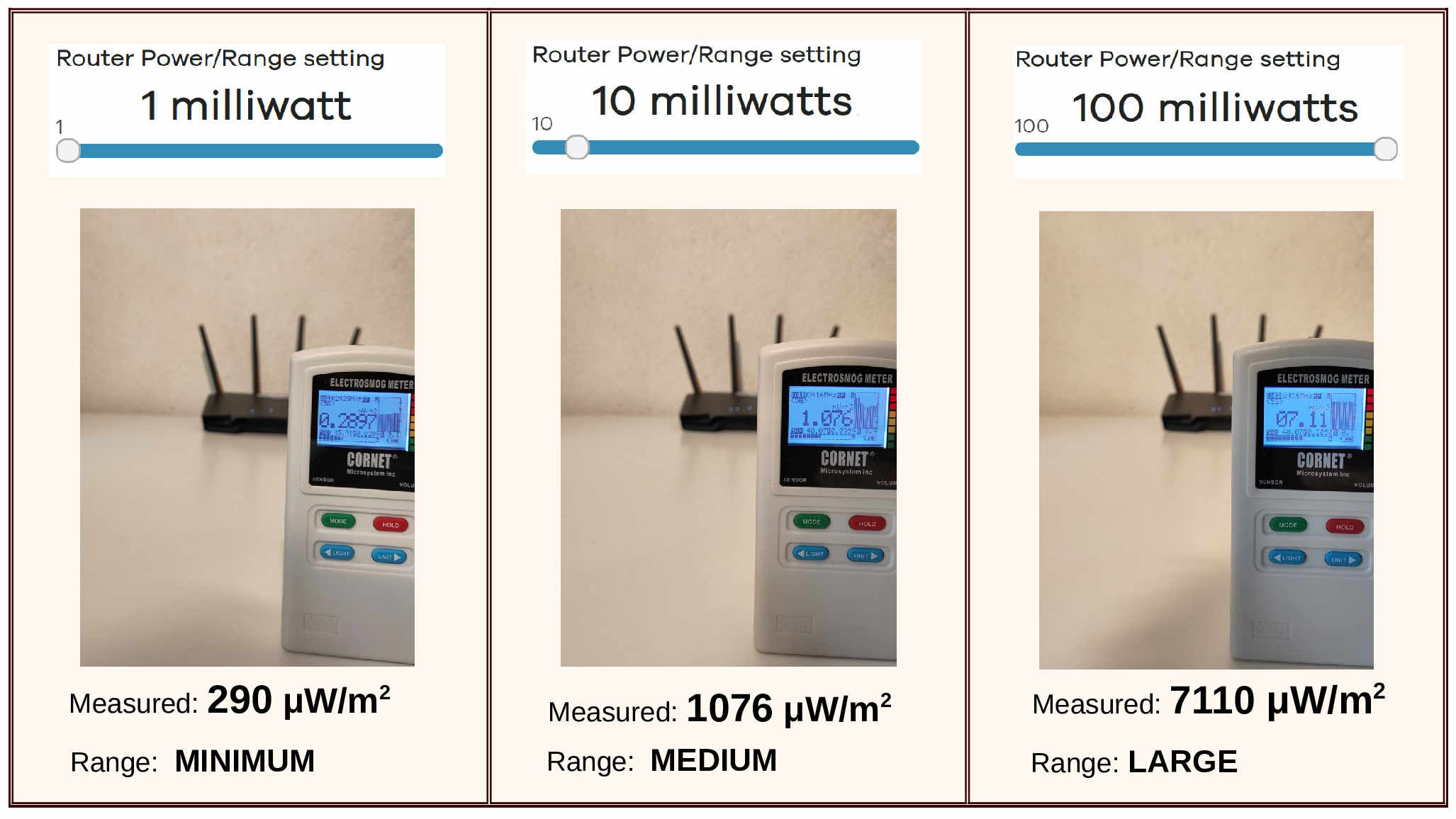 Figure 3. Émissions électromagnétiques du routeur JRS Eco 100 Era, mesurées à l’aide d’un appareil Cornet ED98 QPro 5G à une distance de 0,6 mètre. Pour faciliter la comparaison, la mesure a été effectuée à une distance plus courte, car le Cornet est moins sensible aux fréquences WiFi.
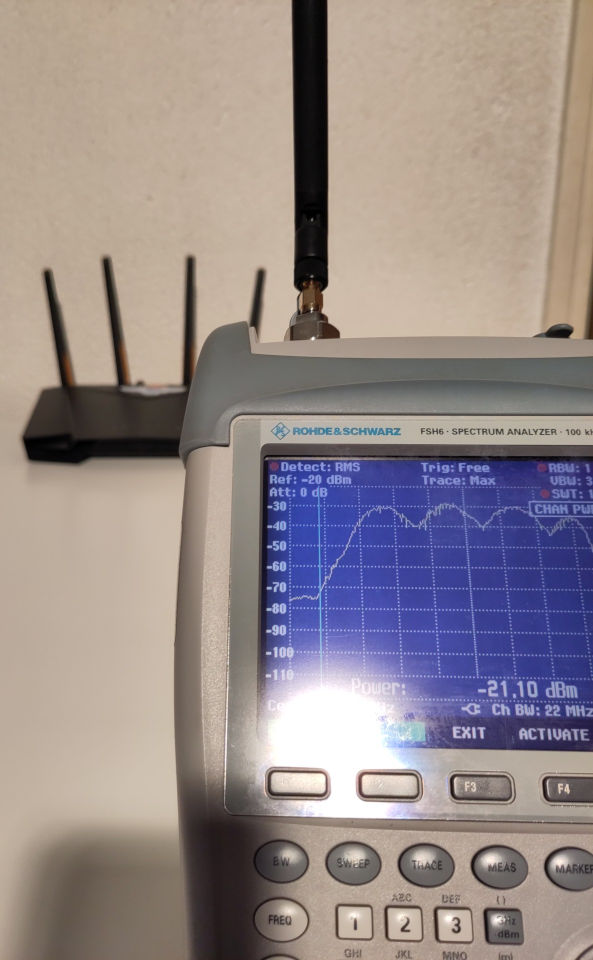 Figure 4. Les mesures effectuées à l’aide de l’analyseur de spectre FSH6 de Rohde & Schwarz confirment le facteur entre les mesures prises avec différents réglages de puissance et de portée. L’analyseur de spectre est l’appareil de mesure le plus précisément étalonné. Cette image montre une mesure de puissance de canal avec un réglage de puissance de 63 milliwatts à une distance de 2 pieds.
Pour en savoir plus :
Le routeur Eco réduit-il la puissance de crête des impulsions ?