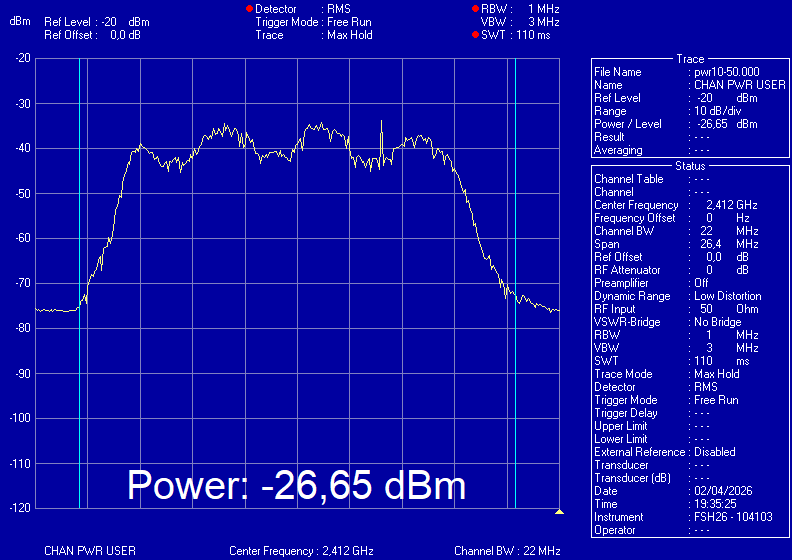
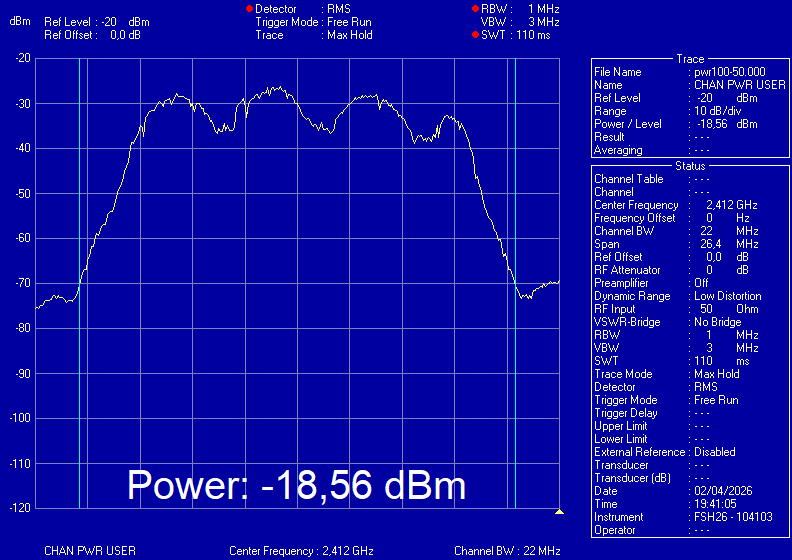
How much less radiation does the JRS Eco 100 router emit compared to an ordinary router? In this test, we demonstrate the difference using two commonly used electromagnetic radiation meters—the Safe and Sound II RF meter and the Cornet ED98 QPro 5G meter.
Measured electromagnetic fields (EMFs) from an ordinary WiFi router
In most cases, ordinary WiFi routers are delivered with a transmission power of 100 milliwatts. Using the Safe and Sound Pro II RF meter at a distance of 2.5 meters from such a standard router, we measure a continuous level of 31,300 microwatts per square meter. Depending on the brand and model of the router, this may differ slightly, but typically the value is in the order of tens of thousands of microwatts per m2. With some models, the user can adjust the transmission power, but in many cases only in very coarse increments—for example, no lower than 33%—and for some models not at all. Furthermore, the number of pulses is important: every ordinary WiFi router transmits 10 beacon pulses per second, 24 hours a day.
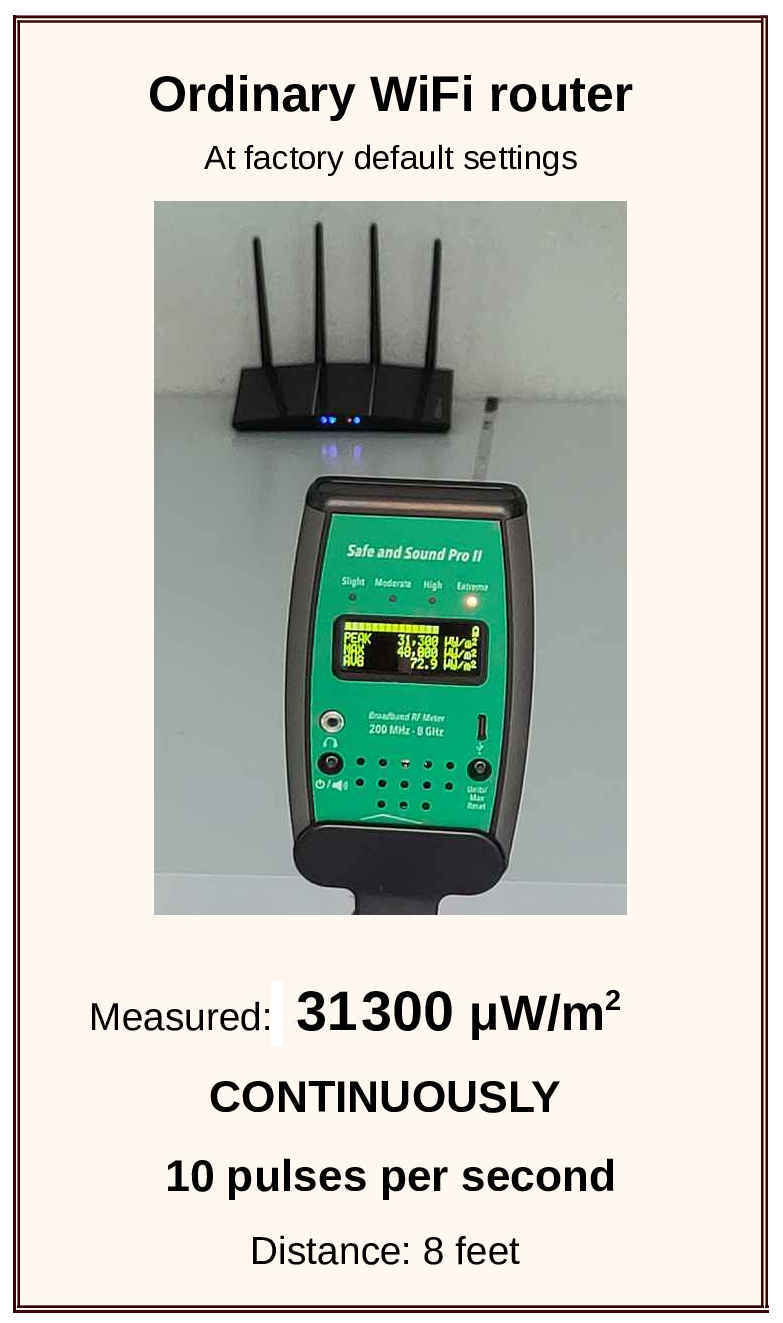 Figure 1. Measured EMFs from an ordinary WiFi router at the factory default settings are 31,300 µW/m², 10 pulses per second. Measured with a Safe and Sound Pro II RF meter at a distance of 8 feet (=2.5 meters). Click image to enlarge.
Range and measured EMFs versus the transmit power setting for the JRS Eco 100 Era router
The JRS Eco 100 Era router emits much less radiation than a standard router. Its default transmission level is already much lower than that of standard routers, and the user can adjust the transmission power very precisely (in 1 dB increments). This allows you to set exactly the range you need—and no more. It can be adjusted in 20 steps, from 1 milliwatt to 100 milliwatts. In addition, the number of pulses per second is reduced by 87% to approximately one pulse per second.
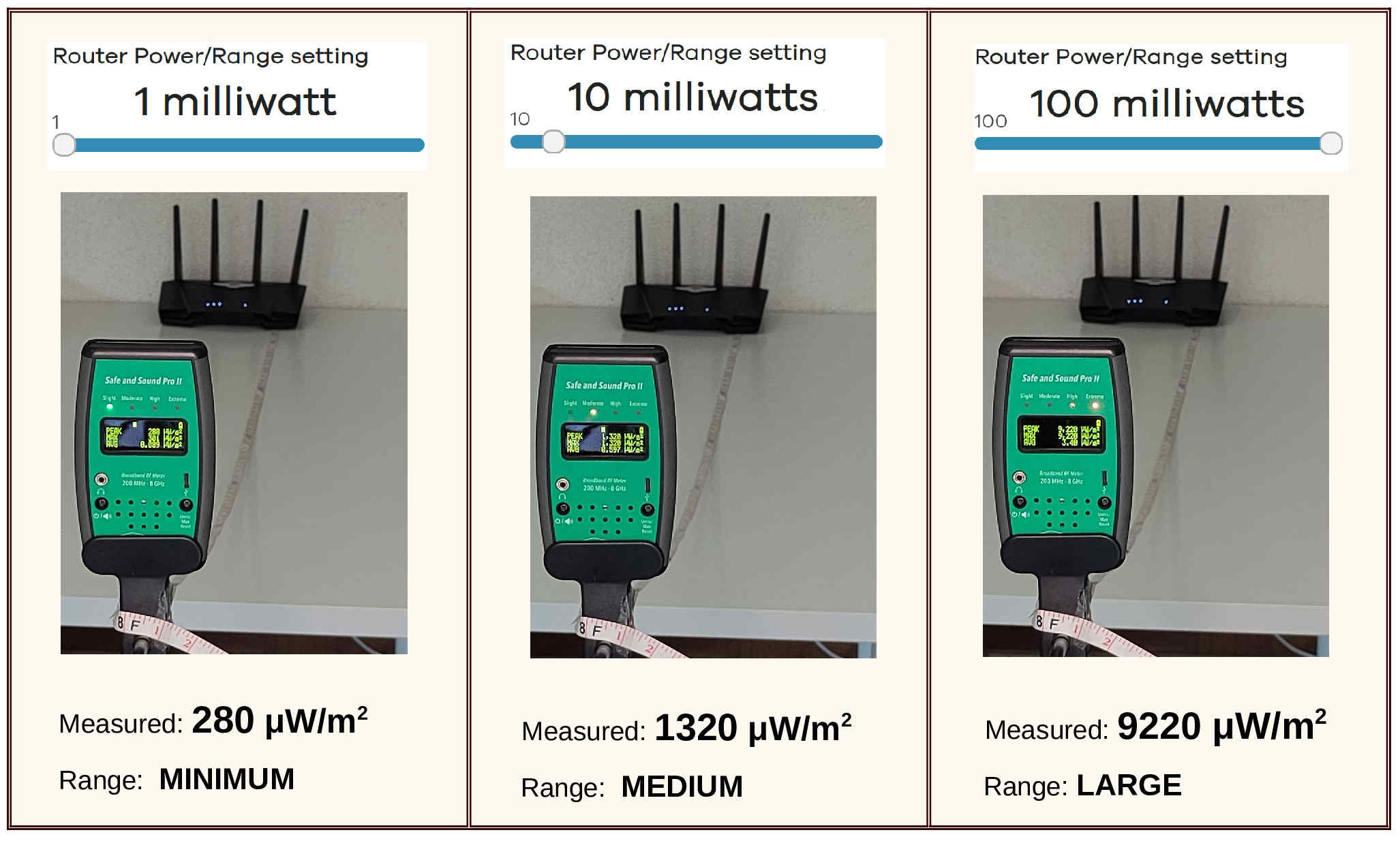 Figure 2. With the output power set to 1 milliwatt, the JRS Eco 100 Era router has the lowest EMF emissions on the market: 280 µW/m², measured with a Safe and Sound Pro II RF meter at a distance of 8 feet (=2.5 meters). Click image to enlarge.
It’s important to understand that transmission power is inextricably linked to the router’s range — it’s a physical fact of life. We ship the JRS routers with an output power of 20 milliwatts by default (previously 63 milliwatts), which provides an adequate range for a medium-sized home. You can manually adjust the output power to suit your needs, giving you exactly the range you want. At a setting of 1 milliwatt, the JRS Eco 100 Era router has the lowest EMF levels of any WiFi router on the market. With the Safe and Sound meter, we measure it at only 280 microwatts per square meter (µW/m²) at a distance of 8 feet.
These values were measured with WiFi enabled on the JRS Eco 100 router. When no WiFi devices are connected, the JRS Eco 100 router is 100% radiation-free.
For the scenario with WiFi enabled, the table below shows the exact measured radiation levels. Since EMF meters from different brands yield different results, we have included measurements taken with both the Safe and Sound Pro II RF meter and the Cornet ED98 QPro 5G meter. The Safe and Sound meter is more sensitive to WiFi frequencies than the Cornet meter and therefore displays higher readings. To facilitate comparison, we held the Cornet meter at a shorter distance (0.6 m versus 2.5 m).
| JRS Eco 100 Era
Power / Range setting * [milliwatt] |
Range | Measured with WiFi active. (When the JRS router is in sleep mode, RF emission is zero.) | |||
|---|---|---|---|---|---|
| Measured with Safe and Sound Pro II RF meter at 8 feet distance | Measured with Cornet ED98 QPro 5G meter at 2 feet distance | Measured with Rohde & Schwarz FSH6 spectrum analyzer at 2 feet distance | |||
| Power density [µW/m2]
(Lower is less EMF) |
Channel power [dBm] (Higher is less EMF, logarithmic) |
||||
| 1 ← Lowest EMF on the market | Minimum | 280 | 290 | -34 | -33.4 |
| 10 | Medium | 1320 | 1076 | -26 | -26.7 |
| 100 | Large | 9220 | 7110 | -18 | -18.6 |
* How can I adjust the transmit power of the JRS Eco 100 Era?
In the US, a higher maximum WiFi power is permitted than in Europe, so an ‘extra large’ range is available for 2.4 GHz in the US (up to 800 milliwatts). However, we do not recommend using it because of the high levels of EMF.
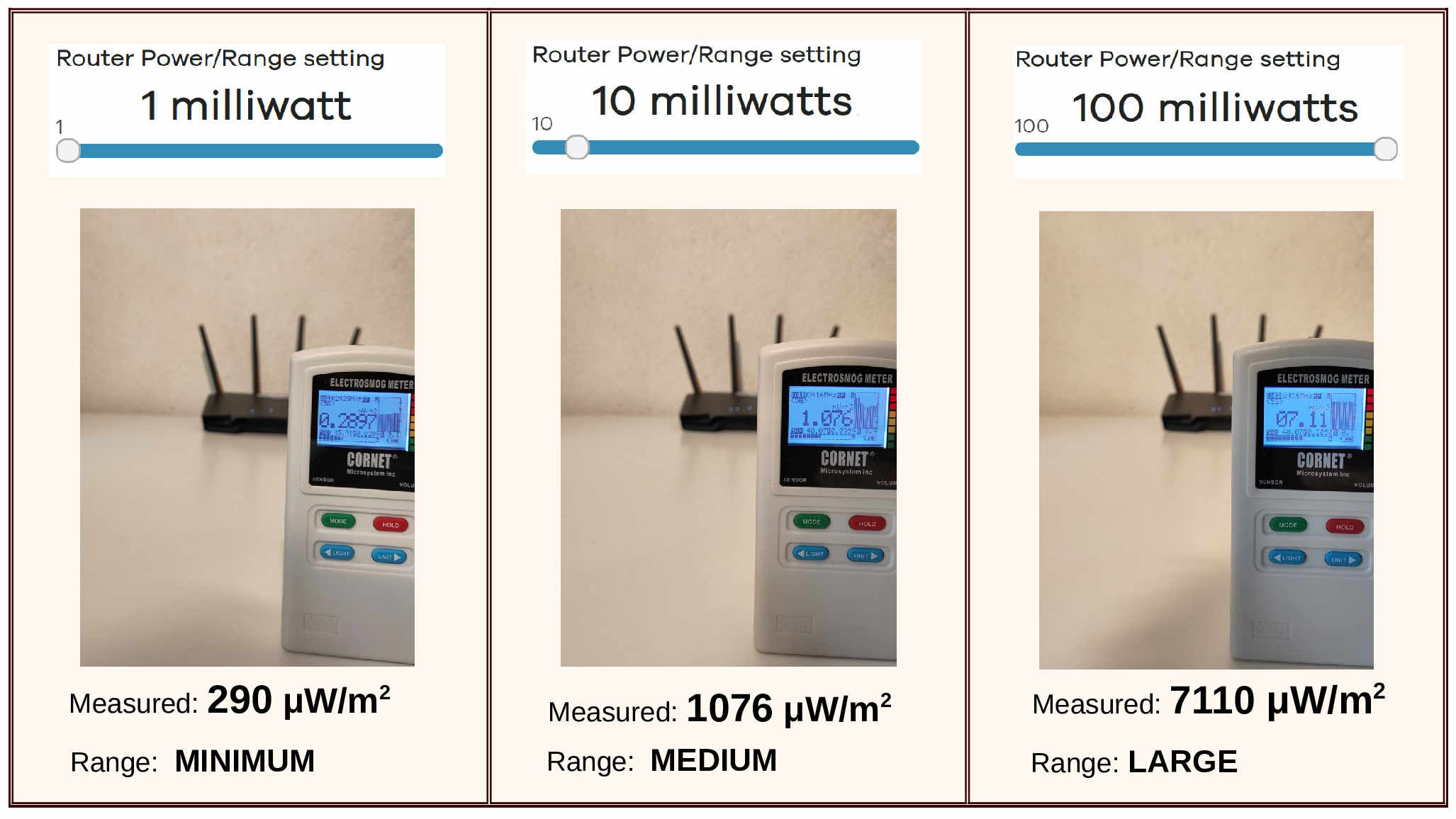 Figure 3. EMF emissions of the JRS Eco 100 Era router, measured with a Cornet ED98 QPro 5G meter at a distance of 2 feet (=0.6 meters). To facilitate comparison, the measurement was taken at a shorter distance, as the Cornet is less sensitive to WiFi frequencies.
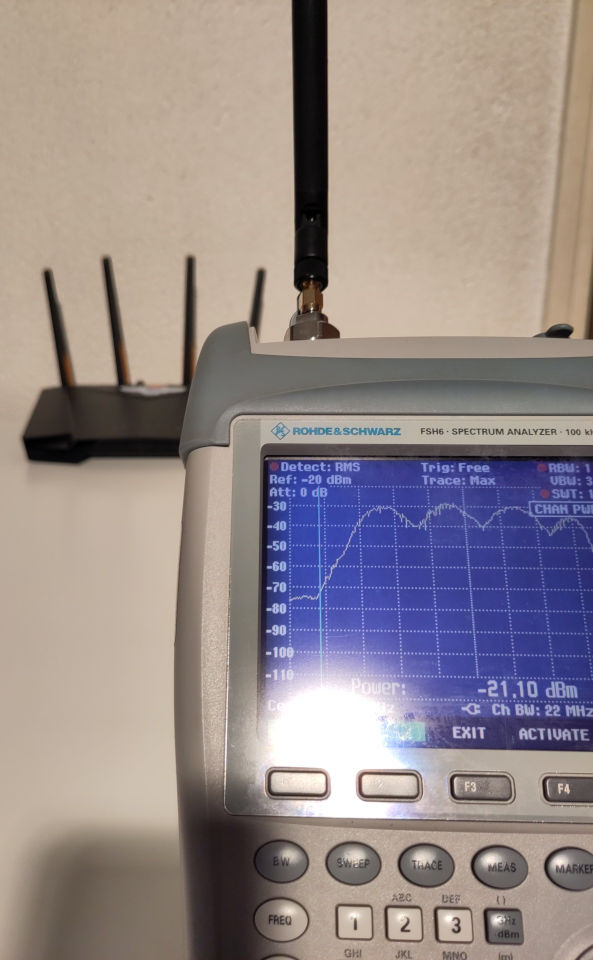 Figure 4. The measurements taken with the Rohde & Schwarz FSH6 spectrum analyzer confirm the factor between the measurements at different power and range settings. The spectrum analyzer is the most accurately calibrated measurement device. This picture shows a channel power measurement at a power setting of 63 milliwatts at 2 feet distance.
Further reading:
Does the Eco router reduce the peak power of the pulses?
Doesn’t the Eco router cause my wireless devices to actually emit more radiation?